
Calculating O3 dose response functions
Ozone (O3) accumulated via flux through the leaf stomata is shown to reduce plant productivity. There is often a linear relationship between O3 accumulated over the leaf lifespan and decline in plant productivity. Using empirical measurements of biomass decline across O3 exposure, we calculate the rate of productivity loss with O3 uptake for a number of tropical tree and crop species for the first time.
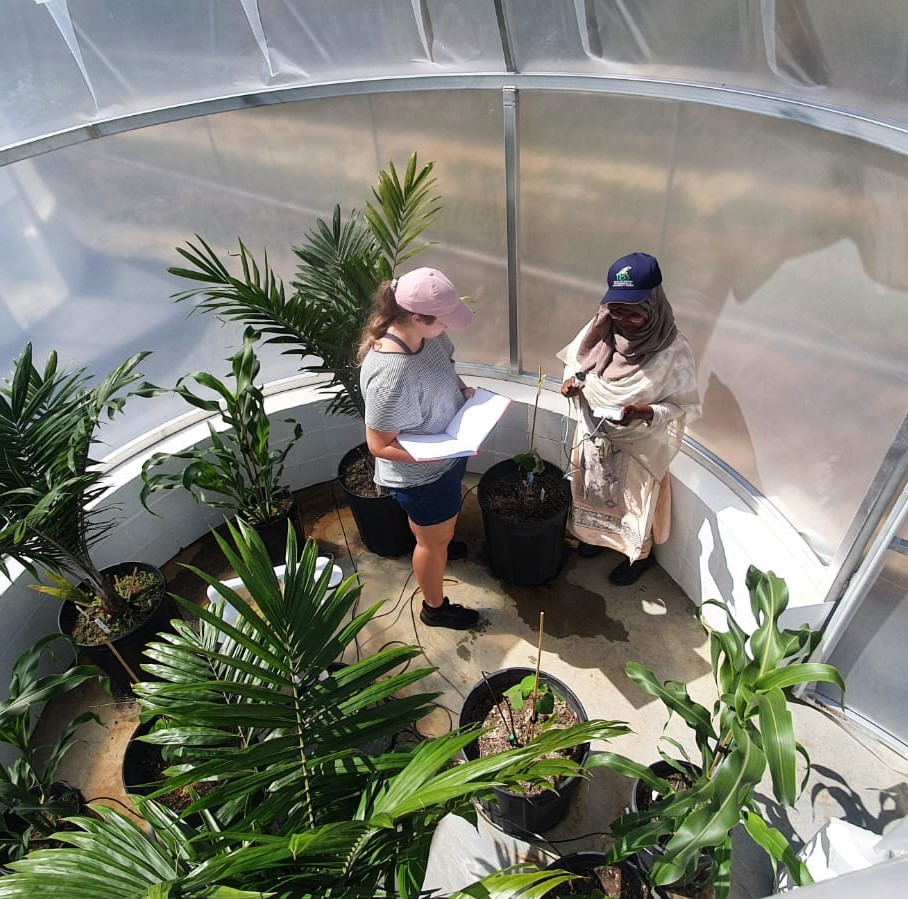
To calculate the cumulative ozone uptake over the experiment period, we estimate the stomatal conductance of O3 for each species over time. We use the DO3SE model (Emberson et al., 2000), which uses hourly meteorology, O3 concentration, and species-specific biophysical parameters to model O3 uptake over the entire experimental period. In our case, the species-specific parameters are fitted using leaf level gas flux data derived from both photosynthesis analyzers (6400XT, LiCor Biosciences) and stomatal conductance meters (SC1, METER).
The DO3SE model includes a threshold below which no (or little) O3 damage occurs. This threshold represents the antioxidant capacity of a species and may differ due to inherent species level differences or due to the influence of nutrient availability
From here, the dose response function is calculated by fitting a linear curve relating the cumulative O3 uptake to the decrease in plant biomass. This dose response function can now be used to model the potential impacts of O3 across tropical systems under various climate and emission scenarios.
 TropOz